
Tuesday, August 11, 2015

Monday, August 10, 2015

Sunday, August 9, 2015
Randy & Jeana

| ||
Saturday, August 8, 2015


Friday, August 7, 2015
F/E Randy Foster..with John's 707....


John and his crew flew this 707 around the world on a publicity tour.
This is a Boeing 707-138B.. It is the same airplane that John Travolta Owns. I flew on this very airplane for 4 years for JOHN TRAVOLTA.


Vultee V-1-----Hey did you notice that the v-1 airplane has the same engine as the DC-3.....WOW

General characteristics
- Crew: 2
- Capacity: 8 passengers
- Length: 37 ft 0 in (11.28 m)
- Wingspan: 50 ft 0 in (15.24 m)
- Height: 10 ft 2 in (3.10 m)
- Wing area: 348 ft2 (32.3 m2)
- Empty weight: 5,332 lb (2,424 kg)
- Gross weight: 8,500 lb (3,864 kg)
- Powerplant: 1 × Wright Cyclone R-1820-F2, 735 hp (548 kW) each
The Lockheed Constilation

General characteristics
- Crew: 5 flight crew, varying cabin crew
- Capacity: typically 62–95 passengers (109 in high-density configuration)
- Length: 116 ft 2 in (35.42 m)
- Wingspan: 126 ft 2 in (38.47 m)
- Height: 24 ft 9 in (7.54 m)
- Wing area: 1,654 ft2 (153.7 m2)
- Empty weight: 79,700 lb (36,150 kg)
- Useful load: 65,300 lb (29,620 kg)
- Max. takeoff weight: 137,500 lb (62,370 kg)
- Powerplant: 4 × Wright R-3350-DA3 Turbo Compound 18-cylinder supercharged radial engines, 3,250 hp (2,424 kW) each
Wednesday, August 5, 2015
Foster, A legend has passed.

It is with a sad and heavy heart to share that
Foster Parsell passed away Tuesday morning in the comfort of his family.
As you all know, Foster was a key aviation leader, teacher and devoted
volunteer for over 22 years with the C.R. Smith
Museum. All of us at the CR Smith Museum will miss him dearly. I do not
yet have information regarding his funeral and arrangements, however I
will share and forward information soon. Please keep Foster’s wife,
Betty, and his family in your thoughts and prayers.
Sincerely,
Monday, August 3, 2015


American Lockheed L-188

| National origin | United States A VERY HIGH PERFORMANCE AIRCRAFT |
|---|---|
| Manufacturer | Lockheed Corporation |
| First flight | December 6, 1957 |
| Introduction | 1959 |
| Status | In limited use[1] |
| Primary users | American Airlines Eastern Air Lines Braniff Airways National Airlines |
| Produced | 1957–61 |
| Number built | 170 |
| Variants General characteristics
|

A tail dragger DC-3.....I'm sure Jack loved the DC-3.

P.S.
I flew with Jack a few times as his Flight Engineer...."Randy Foster"
Sunday, August 2, 2015
The Very first Bricks for Museum.

Notice the I.D. numbers in foreground, Many stacks went in beford the SOUTH wall and the DC-3 wast put inside.
Saturday, August 1, 2015
The Douglas DC-7 The airplane that went non stop coast to coast.

The DC-7 was the queen of the skies from 1953-1958 at the twilight of the piston age, before the 707s and DC-8 quickly relegated them to second tier and freighter status. The DC-7 inaugurated non-stop coast-to-coast service in November 1953. The cockpit and front cabin of Flagship Vermont are preserved for walk throughs.


Friday, July 31, 2015
Is that ME at MEX getting ready to head north......After PO PO of course.
The Douglas DC-6 is a piston-powered airliner and transport aircraft built by the Douglas Aircraft Company from 1946 to 1958. Originally intended as a military transport near the end of World War II, it was reworked after the war to compete with the Lockheed Constellation
in the long-range commercial transport market. More than 700 were built
and many still fly today in cargo, .
The bricks are looking GOOD.

The Famous DC-4.


- Douglas DC-4Airliner
- The Douglas DC-4 is a four-engine propeller-driven airliner developed by the Douglas Aircraft Company. It served during World War II, in the Berlin Airlift and into the 1960s in a military role. From 1945, many civil airlines operated it worldwide. Wikipedia
- Range: 4,200 miles
- Top speed: 280 mph (451 km/h)
- Wingspan: 117'
- Length: 94'
- First flight: 1938
THE MD-80 WAS, AND STILL IS A GREAT TWIN jET.

RETIRING THE MD-80
Jet makes its final trip for American Airlines after 24 years in the sky
Once it rolls into a slot in a long line of fading AA jets, workers here will record its serial numbers, take off its medical equipment and other paraphernalia, drain its tanks and close it up. Unless there’s a change of heart, a sudden surge in business, the airplane has ended its service with American Airlines.
It’s a fate that will be shared over the next few years by the rest of its fleet mates as American retires the remaining airplanes from what used to be the biggest fleet in its history, the McDonnell Douglas MD-80.
At one time, American operated more than 370 MD-80s, which it dubbed the Super 80. Now there are fewer than 160 left, and the fleet will shrink to under 140 by year’s end. By the end of 2018, if plans aren’t changed, the last MD-80 will be out of American’s enormous fleet.
Almost every American pilot of the last three decades has spent time in the MD-80 cockpit. Billy Parker, hired at American in 1989, logged 13,250 flying hours in the plane, which he described as “just a good, reliable pair of blue jeans.”
“It’s not as sexy as the newer airplanes,” he said, “but man, it has been a workhorse.”
Mind you, there’s nothing wrong with N7530, which was delivered to American in September 1990. Its engines are humming, its interior is clean, its skin of polished aluminum still gleams.
Until its last day, it carried hundreds of American Airlines passengers each day throughout the U.S. In the four days before this final flight, it had flown out of its North Texas home to Detroit, El Paso, Little Rock, Milwaukee, Nashville, Oklahoma City, Ontario, Calif., Phoenix, Pittsburgh, Tulsa and Washington, D.C.
Twenty-one flights in all, each beginning or ending at Dallas/Fort Worth International Airport, covering nearly 15,000 miles as the crow flies, somewhat more as air traffic controllers dictate.
The problem with N7530 is simply that it is old. Its lease has about run out. If American were to keep it, it would need an extensive, expensive maintenance overhaul in the near future.
And in a world of $3-a-gallon jet fuel, its newer, more efficient companions in the American fleet have made N7530’s continued service, and that of the other MD-80s, not a money-wise proposition.
American chief executive Doug Parker sums up the MD-80’s problems succinctly: “They’ve become obsolete, really.
“There are new aircraft coming in that are more fuel-efficient, and the cost of fuel is so much higher than when those airplanes were purchased,” Parker said. “The economics are much better to bring in a new airplane because you save enough in fuel.”
Randy Foster holding a photo of a Convair 240 flying over ???.
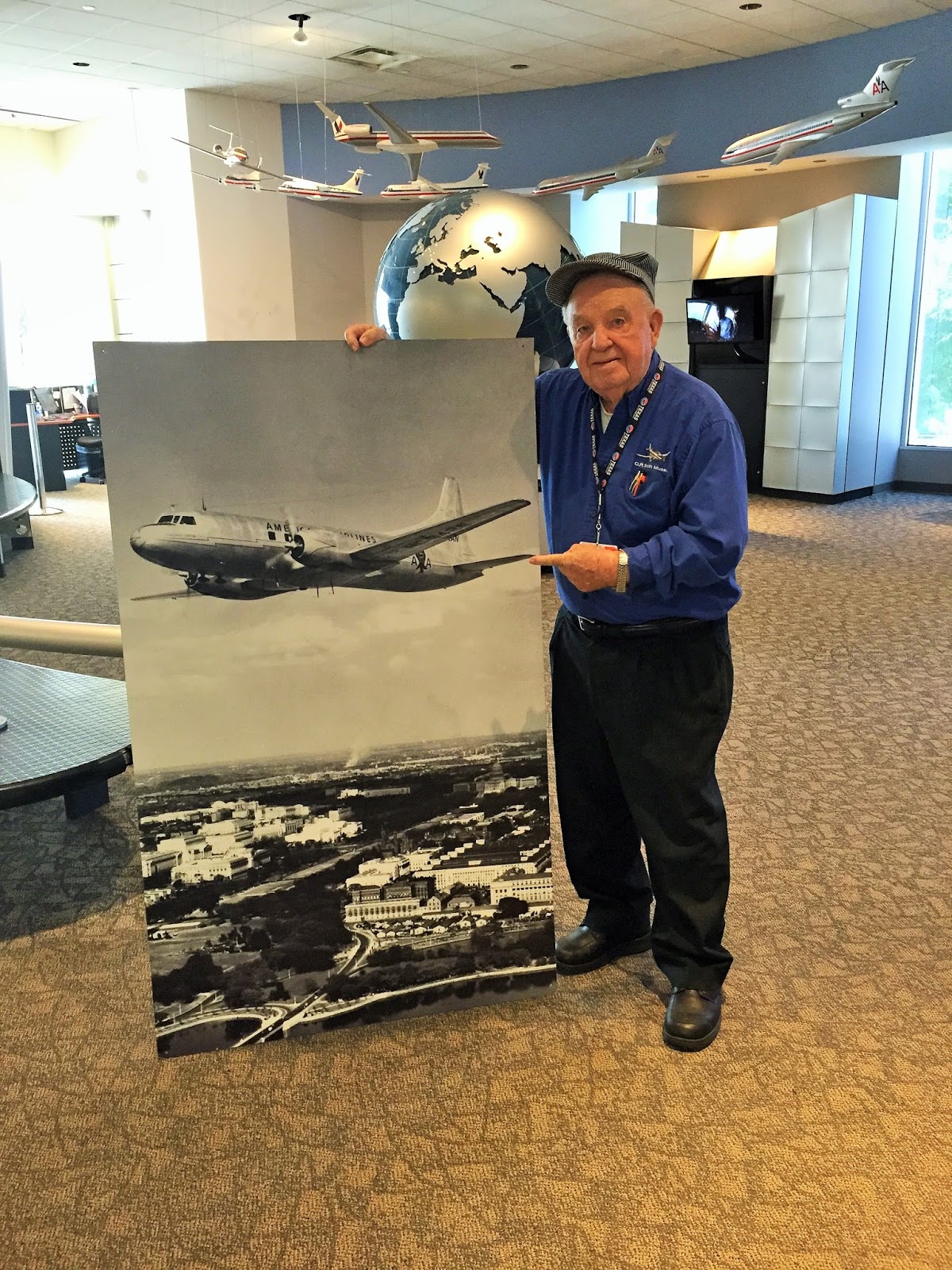
- The Convair CV-240 is an American airliner produced by Convair from 1947 to 1954, initially as a possible replacement of the ubiquitous Douglas DC-3. Wikipedia
- Length: 75'
- First flight: March 16, 1947
Chasity holding a giant picture of a DC-3 flying over Niagra Falls.


Thursday, July 30, 2015


Subscribe to:
Posts (Atom)